
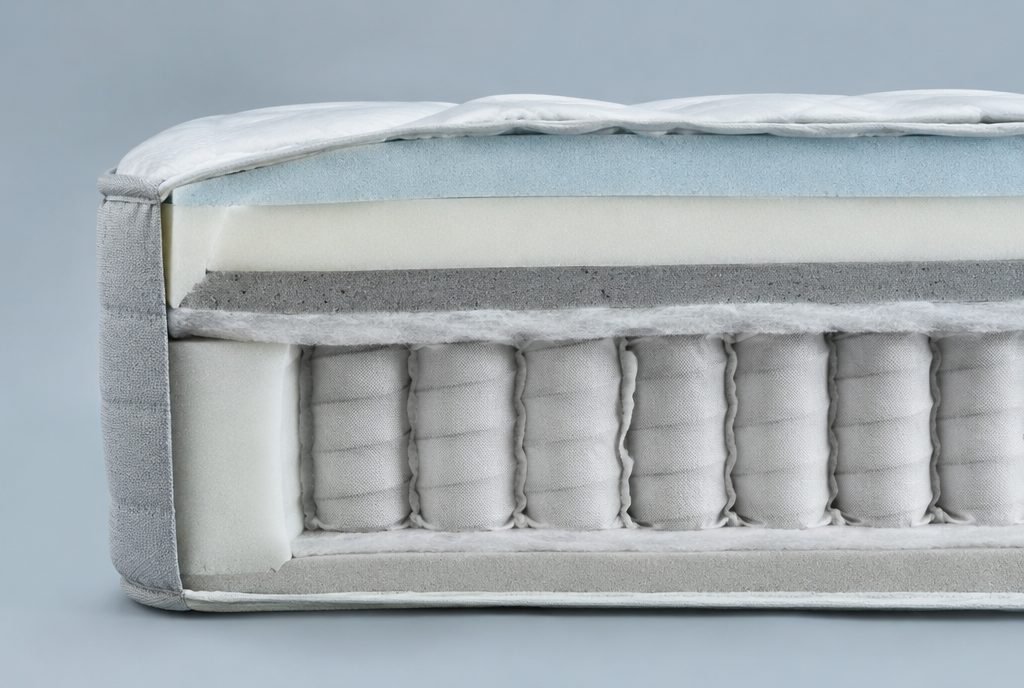
Most mattresses on sale today fall into three families: foam, spring and hybrid. Each has strengths, and the best choice depends on how you sleep, who you share with, how warm you get at night and your budget.
Foam mattresses
Foam mattresses are built from layers of foam, often with a softer comfort layer on top of a firmer base. Memory foam slowly moulds to your body, while other foams feel bouncier.
- Good for: pressure relief, couples who don’t want to feel each other move, and quiet sleep.
- Watch out for: some foams trap heat, and cheaper low-density foam can sag sooner.
Spring mattresses
Spring mattresses use metal coils for support, with padding on top. In pocket-spring designs, each coil sits in its own fabric pocket and moves on its own.
- Good for: airflow and a cooler feel, a bouncy surface that’s easy to move on, and firm edges.
- Watch out for: basic open-coil springs pass movement across the bed and can become noisy over time.
Hybrid mattresses
Hybrids combine a pocket-spring core with thick foam comfort layers on top, aiming for the best of both.
- Good for: balanced support and comfort, better airflow than all-foam, and less motion transfer than basic springs.
- Watch out for: they’re usually heavier and more expensive.
Which should you choose?
- If you sleep hot, lean towards pocket springs or a hybrid with a breathable cover.
- If a restless partner wakes you, foam or a hybrid will isolate movement better.
- If you’re on a tight budget, a good high-density foam mattress is usually better value than a cheap spring one.
Whatever you pick, test it in your usual sleeping position and check the warranty. Our mattress buying checklist covers the questions to ask.
About the author




Leave a Reply